Thursday, 30 April 2009

Main Task - Editing Final Draft
In an attempt to complete some final adjustments to our film project, Hannah and myself came into college with the impression that nothing would go wrong. It seems that technical difficulties have forced us to do with a less impressive final edit.
Although no adjustments are needed to be done to my evaluation because of these difficulties, it is still very much an inconvenience.
Although no adjustments are needed to be done to my evaluation because of these difficulties, it is still very much an inconvenience.
Wednesday, 22 April 2009
Main Task - Evaluation
In what ways does your media product use, develop or challenge forms and conventions of real media products?
Vital parts of the introduction to a film are required to entice the audience to continue watching, as it is the most important part of the film. Our introduction has complied to the codes and conventions of thriller films with the use of:
-Crime in the centre of the plot
Our media project uses hints and suggestions that something most unfortunate is about to happen to the female victim. Excessive stalking is conventionally paired with the crimes of murder, rape or kidnapping.
-A complex narrate structure
Within just the introduction that we filmed it is apparent that a complex narrative structure is used. The switching between both the note writing and the stalking sequence is proof of this as seen below.
-Themes of voyeurism
Our film contains the use of voyeurism, in an interesting way. Our protagonist, the stalker, has an obsessive compulsive disorder in which he is obsessing over watching and following young teenage girls.
-Narrative pattern which establishes enigmas which the viewers expect to be resolved
During the few shots of the stalker at his desk writing a note the audience can see a picture of the girl being stalked. This links the two characters together creating an enigma which an audience would expect to become resolved by the end of the film.
-Features in the Mise-en-Scéne of the film which reflect the protagonists (or characters within the scene) state of mind
At the beginning of the stalking sequence a long panning shot is used from behind some black railings.

This symbolises the entrapment of the girl in the shot being stalked, as she cannot escape the clutches of the stalker.
Although our film does not challenge forms and conventions of real media products, I feel that both myself and Hannah could of done this to create cinematic effect.
How does your media product represent particular social groups?
I believe our film represents the victimisation of working class individuals and is focused upon mainly a mature film-going audience – people of all ages and gender who would enjoy a serious crime thriller. Hannah and I decided to cast herself as the female victim as she is young and blonde, both key features to what we were originally looking for. We then decided, after comparing numerous possible actors, to cast myself as the stalker. Although during the introduction we filmed you do not see the stalkers face, my face would have suited the role as it depicts an older, sun-deprived and anonymous person who is likely to stalk somebody. As there are no lines in the introduction there was a minimal amount of acting talent needed, and as Hannah and I live close to one another it made filming very simple.
What kind of media institution might distribute your media product and why?
At first I thought a fairly large distribution company would distribute our film production. This was because the film is of thriller genre and could potentially have a large target audience. However, as the film, if completed, would have been made by unknown directors and unknown actors and so, would most probably not even interest big distribution firms. It is more realistic that a less known distribution company such as Icon would take our film on board. Icon have distributed films for EM Media who are known for making films with unknown actors, actresses and directors.
Who would be the audience for your media product?
Referring to the Questionnaire both myself and Hannah conducted at the beginning of the coursework, I can deduce that from the peers in our college (aged 16-17) our audience would be person(s) interested in seeing a murder or crime based thriller in which the main protagonists would include both a young female and a male character in his mid twenties to early thirties. This would be alongside an interesting narrative structure and use of dingy alleyways and rundown buildings in the introduction of the film to intrigue the audience into continuing to watch.
How did you attract/address your audience?
We addressed our audience by complying with their requests of dingy alleyways and main protagonists being a young female and a male in his mid-twenties to mid-thirties and sticking to the thriller genre as set at the beginning of the coursework project. To attract a larger audience I would advertise on the web mainly on social networking websites as the targeted audience frequently use these websites. However I would still use conventional posters and television advertisements as well. Possible competitions could be entered by Joe public to entice more people to see the film. Advertisements in newspapers and popular magazines would seemingly attract a larger audience as well.
Within our film Hannah and myself decided to use a female victim in provocative clothing. This should not only add to narrative enigma but also attract a male audience that would enjoy watching scantly clad women in films.
What have you learnt about technologies from the process of constructing this product?
I have personally learnt that with using the cameras there should always be a check to see that everything is where it should be, especially before a long trip to a filming location. The majority of my technological learning has been from using Adobe Premier Pro editing software, as I had limited experience with it beforehand, the practise using it quickly advanced my skills. Specifically I've learnt about adding effects and that each clip may have more than one effect and (or) transition attached to it. By creating numerous different edits both Hannah and I managed to decide upon an excellent final edit. However we did not attempt to use every different effect or transition, as this would of taken up too much needed time. The new and different skills I have learnt from much experience with using Adobe PP should prove very useful in future jobs or university interviews.
Looking back at your preliminary task, what do you feel you have learnt in the progression from it to the full product?
I have learnt that a frequent use of interesting shot angles can be very effective in contrast to long shots of stable angles. Looking at how ineffectively my previous group (including myself) had planned the short piece it has occurred to me that arranging who researches what and how much research is needed. This is also true tot he fact that there were one too many people in the group. After decided to go in a pair with Hannah it seemed a lot easier and simpler to plan and research possible outcomes for the film. Originally I thought the difference between filming and editing a 30 something second short and filming and editing a 2 minute introduction would have been minimal. It turns out that there is such a huge difference that it, at first, made filming and editing quite tiresome. However after getting to grips with the new technology, editing became interesting and fun in comparison. Working in a pair come into good use when having to look over different objectives before filming, for example the lighting, white balance and camera checks. As well as to do different sections in editing; whilst I did the introduction Hannah worked on the ending, and vis versa. I have learnt that the different, sometimes minuscule, aspects to a piece of film can change the meaning of it dramatically. Taking this into consideration I feel the whole pre-production aspect to film making is imperative and without it, filming will become pointless and very stressful.
Vital parts of the introduction to a film are required to entice the audience to continue watching, as it is the most important part of the film. Our introduction has complied to the codes and conventions of thriller films with the use of:
-Crime in the centre of the plot
Our media project uses hints and suggestions that something most unfortunate is about to happen to the female victim. Excessive stalking is conventionally paired with the crimes of murder, rape or kidnapping.
-A complex narrate structure
Within just the introduction that we filmed it is apparent that a complex narrative structure is used. The switching between both the note writing and the stalking sequence is proof of this as seen below.
-Themes of voyeurism
Our film contains the use of voyeurism, in an interesting way. Our protagonist, the stalker, has an obsessive compulsive disorder in which he is obsessing over watching and following young teenage girls.
-Narrative pattern which establishes enigmas which the viewers expect to be resolved
During the few shots of the stalker at his desk writing a note the audience can see a picture of the girl being stalked. This links the two characters together creating an enigma which an audience would expect to become resolved by the end of the film.
-Features in the Mise-en-Scéne of the film which reflect the protagonists (or characters within the scene) state of mind
At the beginning of the stalking sequence a long panning shot is used from behind some black railings.
This symbolises the entrapment of the girl in the shot being stalked, as she cannot escape the clutches of the stalker.
Although our film does not challenge forms and conventions of real media products, I feel that both myself and Hannah could of done this to create cinematic effect.
How does your media product represent particular social groups?
I believe our film represents the victimisation of working class individuals and is focused upon mainly a mature film-going audience – people of all ages and gender who would enjoy a serious crime thriller. Hannah and I decided to cast herself as the female victim as she is young and blonde, both key features to what we were originally looking for. We then decided, after comparing numerous possible actors, to cast myself as the stalker. Although during the introduction we filmed you do not see the stalkers face, my face would have suited the role as it depicts an older, sun-deprived and anonymous person who is likely to stalk somebody. As there are no lines in the introduction there was a minimal amount of acting talent needed, and as Hannah and I live close to one another it made filming very simple.
What kind of media institution might distribute your media product and why?
At first I thought a fairly large distribution company would distribute our film production. This was because the film is of thriller genre and could potentially have a large target audience. However, as the film, if completed, would have been made by unknown directors and unknown actors and so, would most probably not even interest big distribution firms. It is more realistic that a less known distribution company such as Icon would take our film on board. Icon have distributed films for EM Media who are known for making films with unknown actors, actresses and directors.
Who would be the audience for your media product?
Referring to the Questionnaire both myself and Hannah conducted at the beginning of the coursework, I can deduce that from the peers in our college (aged 16-17) our audience would be person(s) interested in seeing a murder or crime based thriller in which the main protagonists would include both a young female and a male character in his mid twenties to early thirties. This would be alongside an interesting narrative structure and use of dingy alleyways and rundown buildings in the introduction of the film to intrigue the audience into continuing to watch.
How did you attract/address your audience?
We addressed our audience by complying with their requests of dingy alleyways and main protagonists being a young female and a male in his mid-twenties to mid-thirties and sticking to the thriller genre as set at the beginning of the coursework project. To attract a larger audience I would advertise on the web mainly on social networking websites as the targeted audience frequently use these websites. However I would still use conventional posters and television advertisements as well. Possible competitions could be entered by Joe public to entice more people to see the film. Advertisements in newspapers and popular magazines would seemingly attract a larger audience as well.
Within our film Hannah and myself decided to use a female victim in provocative clothing. This should not only add to narrative enigma but also attract a male audience that would enjoy watching scantly clad women in films.
What have you learnt about technologies from the process of constructing this product?
I have personally learnt that with using the cameras there should always be a check to see that everything is where it should be, especially before a long trip to a filming location. The majority of my technological learning has been from using Adobe Premier Pro editing software, as I had limited experience with it beforehand, the practise using it quickly advanced my skills. Specifically I've learnt about adding effects and that each clip may have more than one effect and (or) transition attached to it. By creating numerous different edits both Hannah and I managed to decide upon an excellent final edit. However we did not attempt to use every different effect or transition, as this would of taken up too much needed time. The new and different skills I have learnt from much experience with using Adobe PP should prove very useful in future jobs or university interviews.
Looking back at your preliminary task, what do you feel you have learnt in the progression from it to the full product?
I have learnt that a frequent use of interesting shot angles can be very effective in contrast to long shots of stable angles. Looking at how ineffectively my previous group (including myself) had planned the short piece it has occurred to me that arranging who researches what and how much research is needed. This is also true tot he fact that there were one too many people in the group. After decided to go in a pair with Hannah it seemed a lot easier and simpler to plan and research possible outcomes for the film. Originally I thought the difference between filming and editing a 30 something second short and filming and editing a 2 minute introduction would have been minimal. It turns out that there is such a huge difference that it, at first, made filming and editing quite tiresome. However after getting to grips with the new technology, editing became interesting and fun in comparison. Working in a pair come into good use when having to look over different objectives before filming, for example the lighting, white balance and camera checks. As well as to do different sections in editing; whilst I did the introduction Hannah worked on the ending, and vis versa. I have learnt that the different, sometimes minuscule, aspects to a piece of film can change the meaning of it dramatically. Taking this into consideration I feel the whole pre-production aspect to film making is imperative and without it, filming will become pointless and very stressful.
Thursday, 19 March 2009
Main Task - Editing - First Draft
This is our first draft, with the feedback received from our teachers, Hannah and myself have agreed the beginning definitely needs re-filming in a different room with better lighting and camera angles for dramatic effect. We have also agreed that the opening credits should overlap the opening sequence of the letter. This will create more visual stimuli for the audience and also create more content, benefiting both Hannah and myself.
We're both unsure about the music for the stalking section, it seems unfitting. We shall both pursue a new track which is copyright free for this section. Our teachers had pointed out that the end of the film cuts out rather abruptly. This can be fixed with a straight cut to black by adding a black title at the end of the footage.
-
Wednesday, 11 March 2009
Main Task - Filming
Hannah and myself filmed the scene where I, the unknown stalker, am writing a letter to a the possible victim, Hannah. Although lighting was not adequate, we sufficed with none. However the footage is poorly lit and definitely need re-filming, neither of us have time to do so at this point. The footage captured will do as a rough draft of what the scene will look like after the first draft is handed in and feedback is received.
We captured this footage into Adobe Premier Pro straight after filming, so editing may begin Monday morning.
We captured this footage into Adobe Premier Pro straight after filming, so editing may begin Monday morning.
Monday, 9 March 2009
Main Task - Capturing
In an attempt to capture what film we had from last Wednesday on the computer Hannah and myself discovered that the capturing machine was broken and so, maintenance kept us behind an hour more than planned. Although once captured into Adobe Premier Pro we named file according to the scene and setting (to make finding the right footage whilst editing quicker) and disposed of the footage that was unneeded. This has left us both with the correct scenes to add to with our finished filming on Wednesday.
Wednesday, 4 March 2009
Main Task - Filming
During the filming process both myself and Hannah decided to start at the end and film, in the city centre of Nottingham. This was due to difficulties occupying a working camera forcing us to become delayed an hour as a result.To fix this issue of time we both planned to film the section of myself writing the letter next Wednesday.
Upon arrival at our first filming destination I filmed Hannah, the potential female victim, on the tripod walking up the alley several times, and then with a hand held technique for the point of view shots of the stalker, again several times to ensure we had a lot to work with in the editing stages.
Hannah and myself then continued onto our next location, a second alley. We then filmed the same shots using the tripod and without numerous times in the hope of adding to our options in the editing stages.
Finally we moved onto filming Hannah entering the alley from crossing a road as it was originally stated in the storyboard. The location for this section is just outside the second alley, opposite the entrance. We filmed this behind some black railings to symbolise the victims forthcoming entrapment and possible demise. Like before we filmed this sequence several times over to ensure we had a good pan as jerks are easily done on a tripod. We shot a zoomed version of this sequence so we could interchange between each shot at the editing stage.
Although the afternoon was not as successful as expected, we did get some good footage to work with to create an adequate preliminary version to use as a rough guide.
Upon arrival at our first filming destination I filmed Hannah, the potential female victim, on the tripod walking up the alley several times, and then with a hand held technique for the point of view shots of the stalker, again several times to ensure we had a lot to work with in the editing stages.
Hannah and myself then continued onto our next location, a second alley. We then filmed the same shots using the tripod and without numerous times in the hope of adding to our options in the editing stages.
Finally we moved onto filming Hannah entering the alley from crossing a road as it was originally stated in the storyboard. The location for this section is just outside the second alley, opposite the entrance. We filmed this behind some black railings to symbolise the victims forthcoming entrapment and possible demise. Like before we filmed this sequence several times over to ensure we had a good pan as jerks are easily done on a tripod. We shot a zoomed version of this sequence so we could interchange between each shot at the editing stage.
Although the afternoon was not as successful as expected, we did get some good footage to work with to create an adequate preliminary version to use as a rough guide.
Tuesday, 3 March 2009
Monday, 2 March 2009
Main Task - Planning - Risk Assessment
Myself and Hannah have written up a risk assessment together to view possible dangerous activities during the filming process.

Main Task - Planning - Film Schedule
Hannah and myself are going to film the stalking sequence on both the 4th and 5th of March, but due to Hannah's other commitments we were unable to film on the morning of the 5th, and so we decided to film the entire sequence on the afternoon and evening of the 4th. Even so, if we'd filmed in Nottingham City Centre on the afternoon and evening as well as the morning of the 5th, there would be a continuity error due to changes in lighting. We shall commence filming at 12 noon, the scene we shall start with the room including the desk and stalker, this should only take a few minutes to do so. Although we will need to print off many picture of Hannah for the final sequence in this room and so this may take up some of out allotted filming time.
Hannah and myself shall then move onto the stalking sequence in Nottingham City Centre. This scene will involve the general public to co-operate and there is a high possibility of some inconveniences occurring during this sequence, for example an undesired vehicle or person(s) walking in front of the camera, because of this, it may take noticeably longer to film and so will use up more of our filming time.
Hannah and myself shall then move onto the stalking sequence in Nottingham City Centre. This scene will involve the general public to co-operate and there is a high possibility of some inconveniences occurring during this sequence, for example an undesired vehicle or person(s) walking in front of the camera, because of this, it may take noticeably longer to film and so will use up more of our filming time.
Saturday, 28 February 2009
Main Task - Planning - Locations
Myself and Hannah have previously taken a trip into Nottingham City Centre to scout for some possible locations to decide upon before the filming period.
At the beginning of the introduction we decided to film the stalker writing a note at a desk, and so anywhere we can get a dark and mysterious aura and selective lighting, for example school drama rooms or a study room of some kind, would be ideal. However it is irrelevant to which we decide to choose as it would not effect the plot.
Afterwards, for when the audience encounters the stalkers victim, we found several places to shoot the film in. Although not all were satisfactory and so here are the decided locations.


At the beginning of the introduction we decided to film the stalker writing a note at a desk, and so anywhere we can get a dark and mysterious aura and selective lighting, for example school drama rooms or a study room of some kind, would be ideal. However it is irrelevant to which we decide to choose as it would not effect the plot.
Afterwards, for when the audience encounters the stalkers victim, we found several places to shoot the film in. Although not all were satisfactory and so here are the decided locations.


Main Task - Planning - Final Decisions
Chosen Actor:
Both Hannah and myself have discussed some possible actors and due to most promising availability, we agreed on using myself as the male stalker. This decision was also due to the fact that I look much older than the other possible stalkers and we did require an older looking actor.

Chosen Actress:
Again, both Hannah and myself had a long discussion about who could possibly play the role as the young female victim. We gathered that they'd need to be available on possibly the same days as the stalker, that they'd need blond hair and a readily accessible wardrobe of stereotypically 'chav' clothes. We eventually agreed that Hannah would be best suiting for the role as her sister would have many clothes available to us to reduce the cost in budget, she is available on the same days as the stalker and she has blond hair at a satisfying length.

Props:
Our thriller introduction will be limited to two props, a fountain pen and some plain paper. Hannah and myself decided to use a fountain pen because it has connotations of a well educated person whom would carry out the possible crime in an intelligent way to avoid being caught. Fountain pens are also commonly associated with note writing as it allows smooth flow of the pen.
Both Hannah and myself have discussed some possible actors and due to most promising availability, we agreed on using myself as the male stalker. This decision was also due to the fact that I look much older than the other possible stalkers and we did require an older looking actor.

Chosen Actress:
Again, both Hannah and myself had a long discussion about who could possibly play the role as the young female victim. We gathered that they'd need to be available on possibly the same days as the stalker, that they'd need blond hair and a readily accessible wardrobe of stereotypically 'chav' clothes. We eventually agreed that Hannah would be best suiting for the role as her sister would have many clothes available to us to reduce the cost in budget, she is available on the same days as the stalker and she has blond hair at a satisfying length.

Props:
Our thriller introduction will be limited to two props, a fountain pen and some plain paper. Hannah and myself decided to use a fountain pen because it has connotations of a well educated person whom would carry out the possible crime in an intelligent way to avoid being caught. Fountain pens are also commonly associated with note writing as it allows smooth flow of the pen.
Thursday, 26 February 2009
Main Task - Planning - Questionnaire
Both Hannah and myself have created a questionnaire to help us decide upon what an ideal thriller film would be like for our peer group. We asked 30 people so we would receive adequate and accurate results. The results are as followed.
1. How often do you watch films?
a) Weekly - 10
b) Monthly - 17
c) Yearly - 3
2. What genre of film do you mainly like to watch?
a) Romance - 0
b) Thriller - 4
c) Comedy - 6
d) Horror - 10
e) Adventure - 3
f) Action - 2
g) Sci-fi - 5
3. On a scale of 1-5 (1 being not very much, 5 being a lot) How much does the opening of a film influence whether you will continue watching or not?
a) 1 - 1
b) 2 - 0
c) 3 - 0
d) 4 - 5
e) 5 - 24
4. Does having a narrative enigma at the beginning of a film make you want to continue watching it more?
a) Yes - 29
b) No - 1
5. Do you prefer the main protagonists of the films to be - ?
a) Female - young - 13
b) Male - young - 3
c) Female - older - 2
d) Male - older - 12
6. What plot line in thrillers interests you the most?
a) Stalkers - 10
b) Murders - 16
c) Kidnappings - 2
d) Corrupt officials - 2
7. A good setting for a scene in a thriller would be - ?
a) Dingy Alleyway - 11
b) Courtyard/Old house - 6
c) Park at night - 4
d) Run down building - 9
From these results we deduce that the majority of our peers would like to see a horror/thriller film which would, with the use of a practical narrative enigma, keep them 'glued to their seats' from the introduction to the film. Also there should be the use of a young female and an older male involved with or as the main protagonist. A murder or crime plot would be ideal and a dingy alleyway with scenes in a run down building would keep the audience interested in the film.
1. How often do you watch films?
a) Weekly - 10
b) Monthly - 17
c) Yearly - 3
2. What genre of film do you mainly like to watch?
a) Romance - 0
b) Thriller - 4
c) Comedy - 6
d) Horror - 10
e) Adventure - 3
f) Action - 2
g) Sci-fi - 5
3. On a scale of 1-5 (1 being not very much, 5 being a lot) How much does the opening of a film influence whether you will continue watching or not?
a) 1 - 1
b) 2 - 0
c) 3 - 0
d) 4 - 5
e) 5 - 24
4. Does having a narrative enigma at the beginning of a film make you want to continue watching it more?
a) Yes - 29
b) No - 1
5. Do you prefer the main protagonists of the films to be - ?
a) Female - young - 13
b) Male - young - 3
c) Female - older - 2
d) Male - older - 12
6. What plot line in thrillers interests you the most?
a) Stalkers - 10
b) Murders - 16
c) Kidnappings - 2
d) Corrupt officials - 2
7. A good setting for a scene in a thriller would be - ?
a) Dingy Alleyway - 11
b) Courtyard/Old house - 6
c) Park at night - 4
d) Run down building - 9
From these results we deduce that the majority of our peers would like to see a horror/thriller film which would, with the use of a practical narrative enigma, keep them 'glued to their seats' from the introduction to the film. Also there should be the use of a young female and an older male involved with or as the main protagonist. A murder or crime plot would be ideal and a dingy alleyway with scenes in a run down building would keep the audience interested in the film.
Wednesday, 25 February 2009
Main Task - Planning - Brainstorm
Unfortunately because Hannah was withheld for unforeseen circumstances we were unable to meet up and complete the planning, so during today's lesson we both went ahead and began.
Locations
-Back Ally
-School
-Factory Yard
-Streets in a town at night
-Apartment
-Bedroom
-Church
Actors
-A female possible victim aged 15-18
-A male protagonist aged 25-30
Costume
Female – Provocatively dressed, hoop earrings, side pony tail , bright clothes
Male – Smartly dressed, Tattoos, Ripped and tatty clothes, Long hair, messy hair, greasy hair, short hair, balding
Props
-Letter, handbag, fountain pen
Dialogue (if any)
-No dialogue – creates suspense
Lighting
-Naturalistic lighting – dark, streetlights
Camera Angles
-Low angle shots on stalker to symbolise his empowerment
-High angle shots on female victim to symbolise vulnerability
-Close ups and ecu’s to show emotion
-Long shot
-Point of view shot to put the audience in the action
Locations
-Back Ally
-School
-Factory Yard
-Streets in a town at night
-Apartment
-Bedroom
-Church
Actors
-A female possible victim aged 15-18
-A male protagonist aged 25-30
Costume
Female – Provocatively dressed, hoop earrings, side pony tail , bright clothes
Male – Smartly dressed, Tattoos, Ripped and tatty clothes, Long hair, messy hair, greasy hair, short hair, balding
Props
-Letter, handbag, fountain pen
Dialogue (if any)
-No dialogue – creates suspense
Lighting
-Naturalistic lighting – dark, streetlights
Camera Angles
-Low angle shots on stalker to symbolise his empowerment
-High angle shots on female victim to symbolise vulnerability
-Close ups and ecu’s to show emotion
-Long shot
-Point of view shot to put the audience in the action
Monday, 16 February 2009
Main Task - Planning - Research
Today our class began to decide upon our groups. I decided to work with Hannah Godfrey and then we both decided to keep the group to the two of us to avoid conflicting ideas with numerous group members, from personal experience working with Hannah in the past worked out well and to make meeting up to film, plan and discuss out task at hand.
Films:
Fight Club-
Director: David Fincher
Release Date: 12 November 1999
Budget: $63 million US
Gross Revenue: $100,853,753 US
Starring: Edward Norton, Brad Pitt and Helena Bonham Carter.
This film fits conventions of a Thriller genre with the consistent use of twists and turns in the plot, clues to the Narrator figuring out who Tyler is that don't end up helping him, as well as clues that do and the use of long periods of time with increasing incidental music to create tension.
The Genre:
A lot of of Thrillers are hybrids such as action or adventure thrillers, sci-fi thrillers such as Alien (1979), crime-caper thrillers (such as The French Connection (1971), western thrillers such as High Noon (1952), film noir thrillers such as Double Indemnity (1944), even romantic comedy thrillers (such as Safety Last (1923), also the more famous horror thrillers (also occasionally known as chillers) such as Halloween (1978). - http://www.filmsite.org/thrillerfilms.html
In a list of the top 50 Thriller Films according to www.IMDB.com include in the top 5 of these films from between 1954 up to 2008. This suggest that even a 45 year old film can still be regarded as such a high quality thriller in comparison to a film released just last year. - http://www.imdb.com/chart/thriller
Films:
Fight Club-
Director: David Fincher
Release Date: 12 November 1999
Budget: $63 million US
Gross Revenue: $100,853,753 US
Starring: Edward Norton, Brad Pitt and Helena Bonham Carter.
This film fits conventions of a Thriller genre with the consistent use of twists and turns in the plot, clues to the Narrator figuring out who Tyler is that don't end up helping him, as well as clues that do and the use of long periods of time with increasing incidental music to create tension.
The Genre:
A lot of of Thrillers are hybrids such as action or adventure thrillers, sci-fi thrillers such as Alien (1979), crime-caper thrillers (such as The French Connection (1971), western thrillers such as High Noon (1952), film noir thrillers such as Double Indemnity (1944), even romantic comedy thrillers (such as Safety Last (1923), also the more famous horror thrillers (also occasionally known as chillers) such as Halloween (1978). - http://www.filmsite.org/thrillerfilms.html
In a list of the top 50 Thriller Films according to www.IMDB.com include in the top 5 of these films from between 1954 up to 2008. This suggest that even a 45 year old film can still be regarded as such a high quality thriller in comparison to a film released just last year. - http://www.imdb.com/chart/thriller
Monday, 9 February 2009
Saturday, 7 February 2009
Thursday, 5 February 2009
Preliminary Task - Planning - Brainstorm
Setting:
-Airport Hanger
-SWAT Van
-War Zone
-Open Field
-Back of a blacked out van
-Empty Warehouse
-Woods
-Police Station
-Back of shop
-Interrogation Room
-Empty Car Park
Costume:
Interrogator (played by Myself) - Smart Suit and Tie, Shirt tucked in and professional looking.
Pvt Johnson (played by James) - Casual jeans and t-shirt, looks slightly scruffy.
Actors:
Myself - Dark character, Suit looks smart, Possibly pretending to be from the CIA, Willing to do anything to get what he wants, He needs information from James.
James - Ex-Army, Average guy, Taken off the street and confused because of this, there is nothing special about him.
-Airport Hanger
-SWAT Van
-War Zone
-Open Field
-Back of a blacked out van
-Empty Warehouse
-Woods
-Police Station
-Back of shop
-Interrogation Room
-Empty Car Park
Costume:
Interrogator (played by Myself) - Smart Suit and Tie, Shirt tucked in and professional looking.
Pvt Johnson (played by James) - Casual jeans and t-shirt, looks slightly scruffy.
Actors:
Myself - Dark character, Suit looks smart, Possibly pretending to be from the CIA, Willing to do anything to get what he wants, He needs information from James.
James - Ex-Army, Average guy, Taken off the street and confused because of this, there is nothing special about him.
Preliminary Task - Planning - Final Decisions
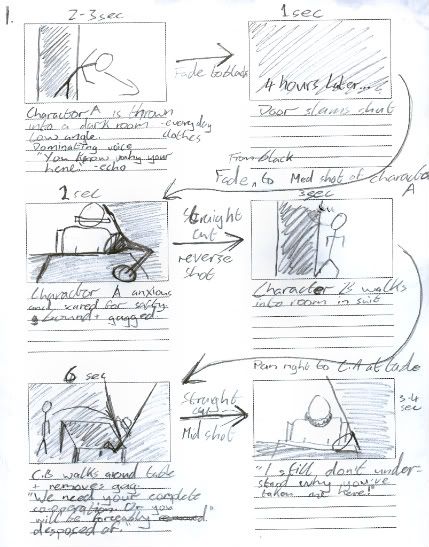
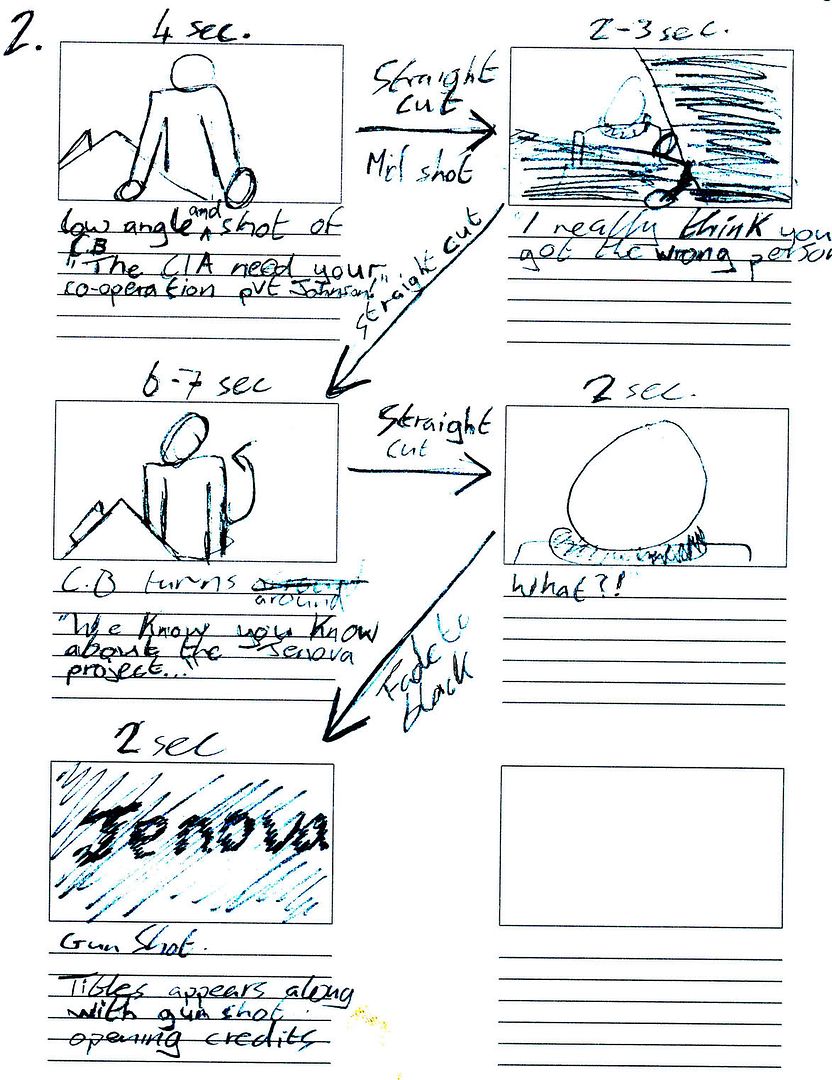
After much discussion and ideas jotted down, we have all agreed to film an interrogation of an ex-army lieutenant who has information about a project named "Jenova" and is reluctant to give away such information. The ex-lieutenant shall be wearing civilian clothing as he was forcibly removed from the public to be interrogated. The interrogator shall be wearing a black suit and be in mostly poor lighting to create mystery as to who it may be. We shall be using a study desk 'flexi' lamp to create a genuine interrogation feel. This lamp shall be pointed directly into James face as this is commonly seen in interrogation scenes. The desk the two characters will be sat at shall be an average size but longer more than it is wide to create distance between the interrogator and the interrogatee symbolic of their characteristic differences. We shall try to use long pauses to create tension while the interrogatee is waiting to be interrogated as this is a common convention in thriller films.
Preliminary Task - Planning - Assignment
Our class has been assigned a short task of filming, in groups of 3+, a sequence in which the audience sees someone entering a room, sitting down with another person and holding a short conversation with them.
The group I was assigned to consisted of Ben Cheatle and James Cook. Immediately we all sat down together and discussed possible plots and characters. After much planning we agreed to film during the next lesson and then any time we had free if needed.
The group I was assigned to consisted of Ben Cheatle and James Cook. Immediately we all sat down together and discussed possible plots and characters. After much planning we agreed to film during the next lesson and then any time we had free if needed.
Wednesday, 4 February 2009
Lost Highway (David Lynch 1997)
I have viewed the introduction to the thriller film The Matrix (Andy and Larry Wachowski, 1999) and have taken notes on the conventions used within the introduction, here is my analysis.
The opening shots are of the road in front of a speeding car driving in the middle of the road. The audience can tell the car is speeding by the road moving very quickly underneath the car and the camera shaking a noticeable amount. As the car is in the middle of the road, it suggests that the driver has no reason to stop for anything that gets in their way. The darkness ahead of the car portrays an unknown path ahead of the driver. This creates the questions: "What is going to happen to the driver?", "Where is the driver going?" and "Why is he driving so fast?" - The convention of creating questions for the audience is typical of a thriller film.
The music in the opening shot is very exciting and fast paced. This creates the thought of something action packed about to happen in the film. The long take of this scene create a lot of tension which conveys the question "What is going to happen?" to the audience, both tension and creation of questions are common conventions for thriller films.
The opening credits seem to fly into screen. This could symbolise the anticipation of the audience, possibly them expecting something else to happen simultaneously to break up the tension. The long take instead continues, creating more and more tension as the film goes along.
A very low lit close up of somebody smoking a cigarette is seen as someone is heard at the door. The man smoking ignores it, as if he were expecting someone he did not want to see. This creates questions such as: "Who is at the door?", "Why is this man not answering the door?". The use of quiet growling sound in the background slowly becoming louder creates tension as to what is going to happen, what is the person at the door going to do? The use of low lighting also portrays the question "Who is this person?", "Who is Dick Murrant?" and "Why is Dick Murrant dead?".
The frequent use of the creation of questions and mysterious characters throughout the introduction to Lost Highway proves that its use of the codes and conventions of the thriller theme are accurate and very well done, making this introduction gripping and interesting, which is what a good thriller should be.
· http://uk.youtube.com/watch?v=iDUaDgzRiFE
The opening shots are of the road in front of a speeding car driving in the middle of the road. The audience can tell the car is speeding by the road moving very quickly underneath the car and the camera shaking a noticeable amount. As the car is in the middle of the road, it suggests that the driver has no reason to stop for anything that gets in their way. The darkness ahead of the car portrays an unknown path ahead of the driver. This creates the questions: "What is going to happen to the driver?", "Where is the driver going?" and "Why is he driving so fast?" - The convention of creating questions for the audience is typical of a thriller film.
The music in the opening shot is very exciting and fast paced. This creates the thought of something action packed about to happen in the film. The long take of this scene create a lot of tension which conveys the question "What is going to happen?" to the audience, both tension and creation of questions are common conventions for thriller films.
The opening credits seem to fly into screen. This could symbolise the anticipation of the audience, possibly them expecting something else to happen simultaneously to break up the tension. The long take instead continues, creating more and more tension as the film goes along.
A very low lit close up of somebody smoking a cigarette is seen as someone is heard at the door. The man smoking ignores it, as if he were expecting someone he did not want to see. This creates questions such as: "Who is at the door?", "Why is this man not answering the door?". The use of quiet growling sound in the background slowly becoming louder creates tension as to what is going to happen, what is the person at the door going to do? The use of low lighting also portrays the question "Who is this person?", "Who is Dick Murrant?" and "Why is Dick Murrant dead?".
The frequent use of the creation of questions and mysterious characters throughout the introduction to Lost Highway proves that its use of the codes and conventions of the thriller theme are accurate and very well done, making this introduction gripping and interesting, which is what a good thriller should be.
· http://uk.youtube.com/watch?v=iDUaDgzRiFE
Mulholland Drive (David Lynch 2001)
I have viewed the introduction to the the Thriller film Mulholland Drive (David Lynch 2001) and have taken notes on the conventions used in this introduction, here is my analysis.
A long to mid shot of numerous people dancing together layered over each other combined with Jazzy 60's music and the dancers' 60's costumes conveys to the audience that it is set in the 60's and creates some confusion due to the amount of people dancing, as well as some questions such as: "Who are these people dancing?" and "Why are they dancing?".
Slowly, three very over exposed people walk towards the screen, as if they were accepting an applause from an audience. They appear to fade in and out in a blurred manor and occasionally shake from side to side, this creates confusing for the audience as they do not know who these three people are and why they are there yet. The creation of these questions is a typical convention of thriller films.
A fade to black takes the audience into a new scene where a point of view shot is used as an unknown person is investigating some bed sheets whist breathing rather heavily. This suggests that they may be a rapist or possible stalker as heavy breathing in this manor is commonly used with such characters. Again the lack of information causes questions to be raised such as: "Who is this person breathing heavily?", "Why are they breathing heavily?" and "Why are they creepily inspecting these bed sheets?". The person who is breathing heavily then moves closer and closer into the sheets as if to grab what looks like a body underneath the sheets. as the screen goes black the audience is taken into the next scene.
The sign for Mulholland Drive appears with some flashes of white lights on the sign. This suggests that something most unfortunate is about to happen to Mulholland Drive. This combined with eerie and slow music creates tension and again portraying questions to the audience such as: "What is going to happen?".
Afterwards it fades into a dark scene following a car on a winding road, the shot is a very high angle and so this makes the car and the person(s) inside is insignificant and disempowered. The opening credits begin to sppear on the screen in the same font and colouring as the Mulholland Drive signpost. This continued theme gives the film a symbolic trademark as now when the audience sees this font and colour combined they will remember the film. The long notes in the music in this scene combined with the long take that this scene is, creates tension for the audience.
The high use of tension and creation of many questions as well as the use of many mysterious and unknown characters throughout the introduction to Mulholland Drive makes the film a typical thriller and it suits the codes and conventions of such a genre.
http://uk.youtube.com/watch?v=1WLWJw9b0HY
A long to mid shot of numerous people dancing together layered over each other combined with Jazzy 60's music and the dancers' 60's costumes conveys to the audience that it is set in the 60's and creates some confusion due to the amount of people dancing, as well as some questions such as: "Who are these people dancing?" and "Why are they dancing?".
Slowly, three very over exposed people walk towards the screen, as if they were accepting an applause from an audience. They appear to fade in and out in a blurred manor and occasionally shake from side to side, this creates confusing for the audience as they do not know who these three people are and why they are there yet. The creation of these questions is a typical convention of thriller films.
A fade to black takes the audience into a new scene where a point of view shot is used as an unknown person is investigating some bed sheets whist breathing rather heavily. This suggests that they may be a rapist or possible stalker as heavy breathing in this manor is commonly used with such characters. Again the lack of information causes questions to be raised such as: "Who is this person breathing heavily?", "Why are they breathing heavily?" and "Why are they creepily inspecting these bed sheets?". The person who is breathing heavily then moves closer and closer into the sheets as if to grab what looks like a body underneath the sheets. as the screen goes black the audience is taken into the next scene.
The sign for Mulholland Drive appears with some flashes of white lights on the sign. This suggests that something most unfortunate is about to happen to Mulholland Drive. This combined with eerie and slow music creates tension and again portraying questions to the audience such as: "What is going to happen?".
Afterwards it fades into a dark scene following a car on a winding road, the shot is a very high angle and so this makes the car and the person(s) inside is insignificant and disempowered. The opening credits begin to sppear on the screen in the same font and colouring as the Mulholland Drive signpost. This continued theme gives the film a symbolic trademark as now when the audience sees this font and colour combined they will remember the film. The long notes in the music in this scene combined with the long take that this scene is, creates tension for the audience.
The high use of tension and creation of many questions as well as the use of many mysterious and unknown characters throughout the introduction to Mulholland Drive makes the film a typical thriller and it suits the codes and conventions of such a genre.
http://uk.youtube.com/watch?v=1WLWJw9b0HY
Tuesday, 3 February 2009
Thriller Conventions
To aid my group and myself I have decided to upload some crucial Thriller Conventions to help guide our journey through creating our very own Thriller.
- Crime in the centre of the plot, often murder.
- A complex narrative structure.
- False clues leading to a 'dead end' in the plot.
- Real clues, resolved, then new clues found as a result.
- Narrative pattern of establishing enigma's which viewers expect to be resolved.
- A protagonist who is systematically dis empowered and is also drawn into a complex or complicated web of intrigue by the antagonist.
- Themes of identity.
- Themes of mirroring.
- Themes of voyeurism.
- A protagonist with a flaw which is taken advantage by an antagonist.
- The title of the film may reflect the protagonist's psychological state of mind.
- There is often a scene towards the end of the film where the protagonist is in peril.
- Features in the Mise-en-Scéne of the film which reflect the protagonists (or characters within the scene) state of mind.
- Crime in the centre of the plot, often murder.
- A complex narrative structure.
- False clues leading to a 'dead end' in the plot.
- Real clues, resolved, then new clues found as a result.
- Narrative pattern of establishing enigma's which viewers expect to be resolved.
- A protagonist who is systematically dis empowered and is also drawn into a complex or complicated web of intrigue by the antagonist.
- Themes of identity.
- Themes of mirroring.
- Themes of voyeurism.
- A protagonist with a flaw which is taken advantage by an antagonist.
- The title of the film may reflect the protagonist's psychological state of mind.
- There is often a scene towards the end of the film where the protagonist is in peril.
- Features in the Mise-en-Scéne of the film which reflect the protagonists (or characters within the scene) state of mind.
Subscribe to:
Posts (Atom)