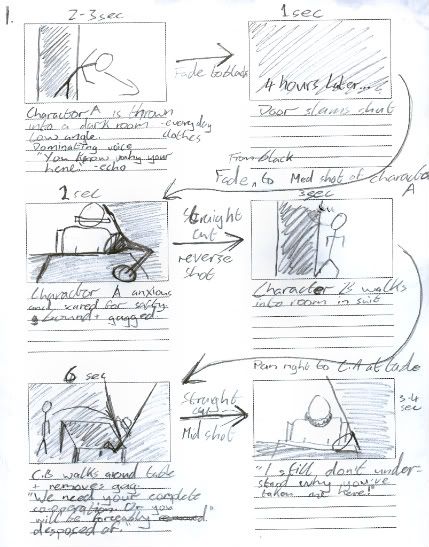
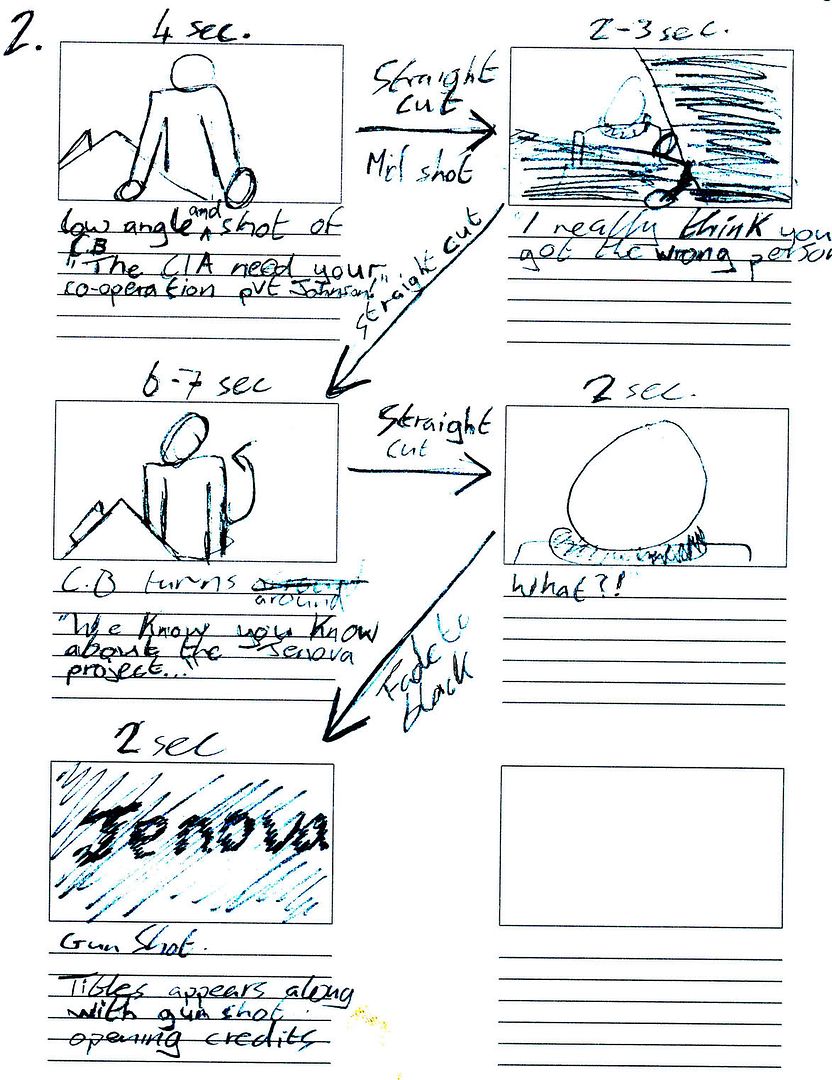
Saturday, 28 February 2009

Main Task - Planning - Locations

Myself and Hannah have previously taken a trip into Nottingham City Centre to scout for some possible locations to decide upon before the filming period.
At the beginning of the introduction we decided to film the stalker writing a no
te at a desk, and so anywhere we can get a dark and mysterious aura and selective lighting, for example school drama rooms or a study room of some kind, would be ideal. However it is irrelevant to which we decide to choose as it would not effect the plot.
Afterwards, for when the audience encounters the stalkers victim, we found several places to shoot the film in. Although not all were satisfactory and so here are the decided locations.

Main Task - Planning - Final Decisions

Chosen Actor:
Both Hannah and myself have discussed some possible actors and due to most promising availability, we agreed on using myself as the male stalker. This decision was also due to the fact that I look much older than the other possible stalkers and we did require an older looking actor.


Chosen Actress:
Again, both Hannah and myself had a long discussion about who could possibly play the role as the young female victim. We gathered that they'd need to be available on possibly the same days as the stalker, that they'd need blond hair and a readily accessible wardrobe of stereotypically 'chav' clothes. We eventually agreed that Hannah would be best suiting for the role as her sister would have many clothes available to us to reduce the cost in budget, she is available on the same days as the stalker and she has blond hair at a satisfying length.


Props:
Our thriller introduction will be limited to two props, a fountain pen and some plain paper. Hannah and myself decided to use a fountain pen because it has connotations of a well educated person whom would carry out the possible crime in an intelligent way to avoid being caught. Fountain pens are also commonly associated with note writing as it allows smooth flow of the pen.

Thursday, 26 February 2009

Main Task - Planning - Questionnaire

Both Hannah and myself have created a questionnaire to help us decide upon what an ideal thriller film would be like for our peer group. We asked 30 people so we would receive adequate and accurate results. The results are as followed.

1. How often do you watch films?

a) Weekly - 10
b) Monthly - 17
c) Yearly - 3


2. What genre of film do you mainly like to watch?

a) Romance - 0
b) Thriller - 4
c) Comedy - 6
d) Horror - 10
e) Adventure - 3
f) Action - 2
g) Sci-fi - 5


3. On a scale of 1-5 (1 being not very much, 5 being a lot) How much does the opening of a film influence whether you will continue watching or not?

a) 1 - 1
b) 2 - 0
c) 3 - 0
d) 4 - 5
e) 5 - 24


4. Does having a narrative enigma at the beginning of a film make you want to continue watching it more?

a) Yes - 29
b) No - 1


5. Do you prefer the main protagonists of the films to be - ?

a) Female - young - 13
b) Male - young - 3
c) Female - older - 2
d) Male - older - 12


6. What plot line in thrillers interests you the most?

a) Stalkers - 10
b) Murders - 16
c) Kidnappings - 2
d) Corrupt officials - 2


7. A good setting for a scene in a thriller would be - ?

a) Dingy Alleyway - 11
b) Courtyard/Old house - 6
c) Park at night - 4
d) Run down building - 9


From these results we deduce that the majority of our peers would like to see a horror/thriller film which would, with the use of a practical narrative enigma, keep them 'glued to their seats' from the introduction to the film. Also there should be the use of a young female and an older male involved with or as the main protagonist. A murder or crime plot would be ideal and a dingy alleyway with scenes in a run down building would keep the audience interested in the film.

Wednesday, 25 February 2009

Main Task - Planning - Brainstorm

Unfortunately because Hannah was withheld for unforeseen circumstances we were unable to meet up and complete the planning, so during today's lesson we both went ahead and began.

Locations
-Back Ally
-School
-Factory Yard
-Streets in a town at night
-Apartment
-Bedroom
-Church


Actors
-A female possible victim aged 15-18
-A male protagonist aged 25-30

Costume
Female – Provocatively dressed, hoop earrings, side pony tail , bright clothes
Male – Smartly dressed, Tattoos, Ripped and tatty clothes, Long hair, messy hair, greasy hair, short hair, balding

Props
-Letter, handbag, fountain pen
Dialogue (if any)
-No dialogue – creates suspense

Lighting
-Naturalistic lighting – dark, streetlights

Camera Angles
-Low angle shots on stalker to symbolise his empowerment
-High angle shots on female victim to symbolise vulnerability
-Close ups and ecu’s to show emotion
-Long shot
-Point of view shot to put the audience in the action

Monday, 16 February 2009

Main Task - Planning - Research

Today our class began to decide upon our groups. I decided to work with Hannah Godfrey and then we both decided to keep the group to the two of us to avoid conflicting ideas with numerous group members, from personal experience working with Hannah in the past worked out well and to make meeting up to film, plan and discuss out task at hand.

Films:

Fight Club-

Director: David Fincher

Release Date: 12 November 1999

Budget: $63 million US

Gross Revenue: $100,853,753 US

Starring: Edward Norton, Brad Pitt and Helena Bonham Carter.

This film fits conventions of a Thriller genre with the consistent use of twists and turns in the plot, clues to the Narrator figuring out who Tyler is that don't end up helping him, as well as clues that do and the use of long periods of time with increasing incidental music to create tension.

The Genre:

A lot of of Thrillers are hybrids such as action or adventure thrillers, sci-fi thrillers such as Alien (1979), crime-caper thrillers (such as The French Connection (1971), western thrillers such as High Noon (1952), film noir thrillers such as Double Indemnity (1944), even romantic comedy thrillers (such as Safety Last (1923), also the more famous horror thrillers (also occasionally known as chillers) such as Halloween (1978). - http://www.filmsite.org/thrillerfilms.html
In a list of the top 50 Thriller Films according to www.IMDB.com include in the top 5 of these films from between 1954 up to 2008. This suggest that even a 45 year old film can still be regarded as such a high quality thriller in comparison to a film released just last year. - http://www.imdb.com/chart/thriller

Thursday, 5 February 2009

Preliminary Task - Planning - Brainstorm

Setting:
-Airport Hanger
-SWAT Van
-War Zone
-Open Field
-Back of a blacked out van
-Empty Warehouse
-Woods
-Police Station
-Back of shop
-Interrogation Room
-Empty Car Park

Costume:
Interrogator (played by Myself) - Smart Suit and Tie, Shirt tucked in and professional looking.
Pvt Johnson (played by James) - Casual jeans and t-shirt, looks slightly scruffy.

Actors:
Myself - Dark character, Suit looks smart, Possibly pretending to be from the CIA, Willing to do anything to get what he wants, He needs information from James.
James - Ex-Army, Average guy, Taken off the street and confused because of this, there is nothing special about him.

Preliminary Task - Planning - Final Decisions

After much discussion and ideas jotted down, we have all agreed to film an interrogation of an ex-army lieutenant who has information about a project named "Jenova" and is reluctant to give away such information. The ex-lieutenant shall be wearing civilian clothing as he was forcibly removed from the public to be interrogated. The interrogator shall be wearing a black suit and be in mostly poor lighting to create mystery as to who it may be. We shall be using a study desk 'flexi' lamp to create a genuine interrogation feel. This lamp shall be pointed directly into James face as this is commonly seen in interrogation scenes. The desk the two characters will be sat at shall be an average size but longer more than it is wide to create distance between the interrogator and the interrogatee symbolic of their characteristic differences. We shall try to use long pauses to create tension while the interrogatee is waiting to be interrogated as this is a common convention in thriller films.

Preliminary Task - Planning - Assignment

Our class has been assigned a short task of filming, in groups of 3+, a sequence in which the audience sees someone entering a room, sitting down with another person and holding a short conversation with them.

The group I was assigned to consisted of Ben Cheatle and James Cook. Immediately we all sat down together and discussed possible plots and characters. After much planning we agreed to film during the next lesson and then any time we had free if needed.

Wednesday, 4 February 2009

Lost Highway (David Lynch 1997)

I have viewed the introduction to the thriller film The Matrix (Andy and Larry Wachowski, 1999) and have taken notes on the conventions used within the introduction, here is my analysis.

The opening shots are of the road in front of a speeding car driving in the middle of the road. The audience can tell the car is speeding by the road moving very quickly underneath the car and the camera shaking a noticeable amount. As the car is in the middle of the road, it suggests that the driver has no reason to stop for anything that gets in their way. The darkness ahead of the car portrays an unknown path ahead of the driver. This creates the questions: "What is going to happen to the driver?", "Where is the driver going?" and "Why is he driving so fast?" - The convention of creating questions for the audience is typical of a thriller film.

The music in the opening shot is very exciting and fast paced. This creates the thought of something action packed about to happen in the film. The long take of this scene create a lot of tension which conveys the question "What is going to happen?" to the audience, both tension and creation of questions are common conventions for thriller films.

The opening credits seem to fly into screen. This could symbolise the anticipation of the audience, possibly them expecting something else to happen simultaneously to break up the tension. The long take instead continues, creating more and more tension as the film goes along.

A very low lit close up of somebody smoking a cigarette is seen as someone is heard at the door. The man smoking ignores it, as if he were expecting someone he did not want to see. This creates questions such as: "Who is at the door?", "Why is this man not answering the door?". The use of quiet growling sound in the background slowly becoming louder creates tension as to what is going to happen, what is the person at the door going to do? The use of low lighting also portrays the question "Who is this person?", "Who is Dick Murrant?" and "Why is Dick Murrant dead?".

The frequent use of the creation of questions and mysterious characters throughout the introduction to Lost Highway proves that its use of the codes and conventions of the thriller theme are accurate and very well done, making this introduction gripping and interesting, which is what a good thriller should be.

· http://uk.youtube.com/watch?v=iDUaDgzRiFE

Mulholland Drive (David Lynch 2001)

I have viewed the introduction to the the Thriller film Mulholland Drive (David Lynch 2001) and have taken notes on the conventions used in this introduction, here is my analysis.

A long to mid shot of numerous people dancing together layered over each other combined with Jazzy 60's music and the dancers' 60's costumes conveys to the audience that it is set in the 60's and creates some confusion due to the amount of people dancing, as well as some questions such as: "Who are these people dancing?" and "Why are they dancing?".

Slowly, three very over exposed people walk towards the screen, as if they were accepting an applause from an audience. They appear to fade in and out in a blurred manor and occasionally shake from side to side, this creates confusing for the audience as they do not know who these three people are and why they are there yet. The creation of these questions is a typical convention of thriller films.

A fade to black takes the audience into a new scene where a point of view shot is used as an unknown person is investigating some bed sheets whist breathing rather heavily. This suggests that they may be a rapist or possible stalker as heavy breathing in this manor is commonly used with such characters. Again the lack of information causes questions to be raised such as: "Who is this person breathing heavily?", "Why are they breathing heavily?" and "Why are they creepily inspecting these bed sheets?". The person who is breathing heavily then moves closer and closer into the sheets as if to grab what looks like a body underneath the sheets. as the screen goes black the audience is taken into the next scene.

The sign for Mulholland Drive appears with some flashes of white lights on the sign. This suggests that something most unfortunate is about to happen to Mulholland Drive. This combined with eerie and slow music creates tension and again portraying questions to the audience such as: "What is going to happen?".

Afterwards it fades into a dark scene following a car on a winding road, the shot is a very high angle and so this makes the car and the person(s) inside is insignificant and disempowered. The opening credits begin to sppear on the screen in the same font and colouring as the Mulholland Drive signpost. This continued theme gives the film a symbolic trademark as now when the audience sees this font and colour combined they will remember the film. The long notes in the music in this scene combined with the long take that this scene is, creates tension for the audience.

The high use of tension and creation of many questions as well as the use of many mysterious and unknown characters throughout the introduction to Mulholland Drive makes the film a typical thriller and it suits the codes and conventions of such a genre.

http://uk.youtube.com/watch?v=1WLWJw9b0HY

Tuesday, 3 February 2009

Thriller Conventions

To aid my group and myself I have decided to upload some crucial Thriller Conventions to help guide our journey through creating our very own Thriller.
- Crime in the centre of the plot, often murder.
- A complex narrative structure.
- False clues leading to a 'dead end' in the plot.
- Real clues, resolved, then new clues found as a result.
- Narrative pattern of establishing enigma's which viewers expect to be resolved.
- A protagonist who is systematically dis empowered and is also drawn into a complex or complicated web of intrigue by the antagonist.
- Themes of identity.
- Themes of mirroring.
- Themes of voyeurism.
- A protagonist with a flaw which is taken advantage by an antagonist.
- The title of the film may reflect the protagonist's psychological state of mind.
- There is often a scene towards the end of the film where the protagonist is in peril.
- Features in the Mise-en-Scéne of the film which reflect the protagonists (or characters within the scene) state of mind.